
More reason not to use Blogger or Blogspot for your law blog
More reason not to use Google’s free Blogger blog service for your law blogs comes from Loren Baker, Editor of the Search Engine Journal.
As Loren explains, if you have a Blogger blog, this could happen to your blog.
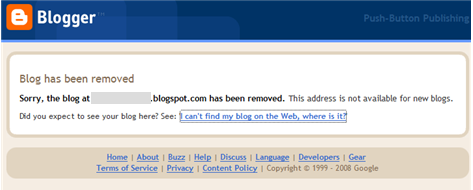
How? Look at Google’s terms of service.
Google may, in its sole discretion, at any time and for any reason, terminate the Service, terminate this Agreement, or suspend or terminate your account. In the event of termination, your account will be disabled and you may not be granted access to your account or any files or other content contained in your account although residual copies of information may remain in our system for some time for back-up purposes.
There are a significant number of lawyers using Google’s Blogger platform and Google’s Blogspot hosting for their blog. As Loren says using the Blogger-Blogspot combination ‘takes away the heart of your blog and hands it over to Google. They control your blog, not you.’
What’s especially surprising is that it’s pretty unlikely these same lawyers would advise their clients to hand over their intellectual capital and marketing materials to a third party and forego all control.
Look at some of the other provisions in the Blogger Terms of Service. Provisions a lawyer would never agree to any contract they would negotiate.
- General Practices Regarding Use and Storage. You agree that Google has no responsibility or liability for the deletion of, or the failure to store or to transmit, any Content and other communications maintained by the Service. Google retains the right to create limits on use and storage at our sole discretion at any time with or without notice.
- Google also reserves the right to access, read, preserve, and disclose any information as it reasonably believes is necessary to (a) satisfy any applicable law, regulation, legal process or governmental request, (b) enforce this Agreement, including investigation of potential violations hereof, (c) detect, prevent, or otherwise address fraud, security or technical issues, (d) respond to user support requests, or (e) protect the rights, property or safety of Google, its users and the public.
- By submitting, posting or displaying Content on or through Google services which are intended to be available to the members of the public, you grant Google a worldwide, non-exclusive, royalty-free license to reproduce, publish and distribute such Content on Google services for the purpose of displaying and distributing Google services. Google furthermore reserves the right to refuse to accept, post, display or transmit any Content in its sole discretion.
Really going to advise your law firm to take these kind of risks? I can tell you that I haven’t talked to many, if any, lawyers who would agree to those terms if we used them in a LexBlog agreement.
But Hey, it’s free. ;)